

Los Angeles Launches Revenue Sharing Program For Illegal Dispensaries
- Jun 22
- 3 min read
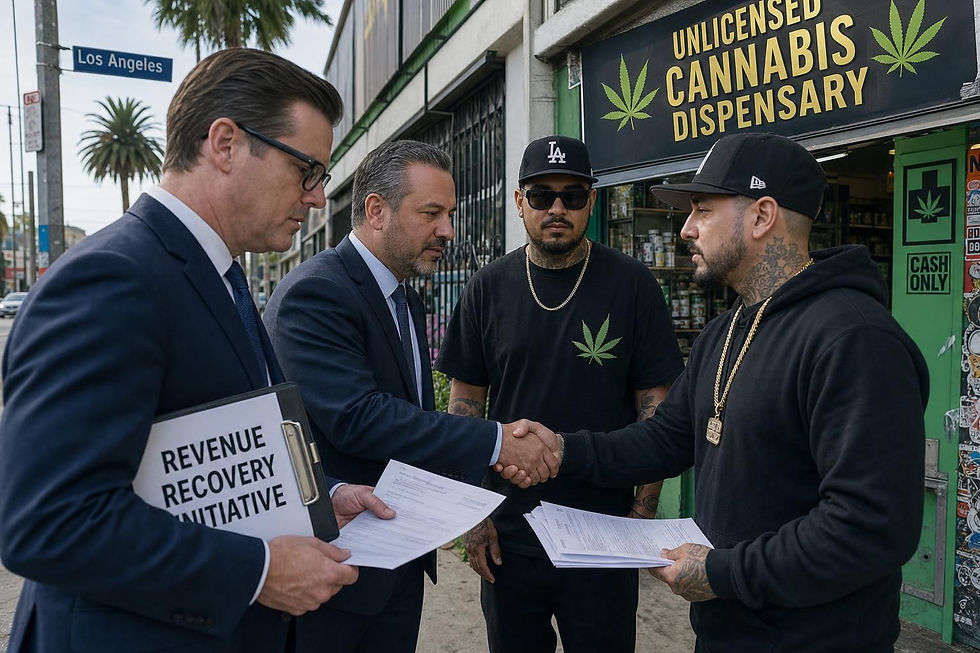
City Officials Pivot From "Enforcement" To "Okay, But What's Our Cut?"
LOS ANGELES — After years of raids, lawsuits, enforcement campaigns, press conferences, task forces, working groups, community outreach initiatives, strongly worded statements, and approximately seventeen thousand declarations that they were "finally getting serious" about illegal cannabis shops, Los Angeles officials have unveiled an innovative new strategy.
Monetize them.
Last week, Los Angeles voted to increase taxes on unlicensed cannabis operators, effectively acknowledging one of the worst-kept secrets in American cannabis: The illegal market isn't going anywhere.
At this point, city officials appear to have reached the final stage of cannabis regulation grief.
Acceptance.
"We've tried shutting them down," one official reportedly explained. "Have we considered just getting a percentage instead?"
Thus was born the latest chapter in California cannabis policy: If you can't beat 'em, tax 'em.
Years Of Enforcement Finally Lead To Basic Arithmetic
The story of California cannabis regulation has always been one of optimism.
Optimism that consumers would gladly pay more for legal products.
Optimism that licensing costs would balance themselves out.
Optimism that taxes wouldn't fundamentally alter consumer behavior.
Optimism that people selling weed illegally would simply stop because somebody put together a nice website explaining regulations.
Reality, meanwhile, had other plans.
Illegal dispensaries kept opening.
Consumers kept shopping there.
Operators kept complaining.
Legal businesses kept closing.
And Los Angeles kept discovering that shutting down one unlicensed dispensary often resulted in two more opening down the street.
Eventually, even the most optimistic regulators had to confront a difficult truth: You cannot out-compete "same product, less money" using paperwork.
The City's Relationship With Drug Dealers Enters Its Mature Phase
Experts describe relationships as progressing through several stages.
Attraction.
Commitment.
Conflict.
Compromise.
Los Angeles has apparently entered compromise.
The city spent years insisting unlicensed cannabis operators represented an existential threat to public safety and the integrity of the legal market.
Now officials are essentially standing outside their shops asking: "So... what are we thinking? Fifteen percent? Twenty? We can be flexible."
Several legal operators expressed confusion.
"You mean to tell me we spent millions on licenses, attorneys, security requirements, compliance systems, testing costs, local approvals, state approvals, packaging regulations, labor requirements, and taxes," said one operator, "only for the city to eventually walk into the illegal market and say, 'Everybody eats'?"
Strong point.
The Underground Economy Partnership Initiative
While city officials have stopped short of describing the proposal as a revenue-sharing agreement with drug dealers, the distinction increasingly feels philosophical.
Boof du Jour obtained what appears to be an internal draft presentation outlining future opportunities for collaboration.
Potential initiatives reportedly include:
The Underground Revenue Alignment Program
Community-Based Alternative Tax Collection
Operation Everybody Eats
The Cannabis Compliance Friendship Tour
Cashing In On Crime: A Strategic Framework
One slide simply read: "Could We At Least Get Something Out Of This?"
The answer appears to be yes.
The Illegal Market Continues Its Unfair Practice Of Existing
Perhaps the funniest part of the entire situation is that none of this should surprise anyone.
The illegal market offers:
lower prices
fewer taxes
less bureaucracy
fewer purchasing barriers
convenience
products consumers already know
The legal market offers:
taxes
additional taxes
local taxes
state taxes
compliance costs
testing costs
licensing fees
and a checkout experience occasionally rivaling the DMV.
Then regulators spend years wondering why consumers vote with their wallets.
The mystery persists.
Legal Operators Discover They Were Playing A Different Game
California's licensed cannabis businesses have spent years trying to survive an environment many describe as impossible.
Margins shrink.
Costs rise.
Taxes increase.
Competition intensifies.
Stores close.
Brands disappear.
Entire businesses collapse under the weight of regulations they were assured would create a fair marketplace.
Meanwhile, their illegal competitors continue operating with all the confidence of a guy who knows the substitute teacher isn't taking attendance.
Now those same operators get to watch local government arrive at the following conclusion:
Maybe the real solution wasn't enforcement.
Maybe it was invoicing.
The Future Of Cannabis Regulation
To be fair to Los Angeles officials, this isn't necessarily surrender.
It's adaptation.
Eventually reality arrives.
Reality does not care about policy intentions.
Reality does not care about campaign promises.
Reality does not care about stakeholder meetings.
Reality cares about incentives.
And consumers generally enjoy paying less money for identical products.
This revelation has devastated regulators nationwide.
Several are reportedly conducting emergency reviews into whether people also prefer:
shorter lines
easier transactions
lower prices
and not paying seventeen different taxes on an eighth of weed.
Early findings suggest they do.
Closing Arguments
For years, Los Angeles promised to defeat the illegal cannabis market.
Instead, it appears the city has simply decided to monetize it.
At press time, officials denied the move represented a concession, insisting they remain fully committed to eliminating illegal cannabis operations.
Just as soon as they figure out how to invoice them.


Comments