

Raj Mukherji Opens Casting Call for Social Equity Owners, Speaking Roles Not Included
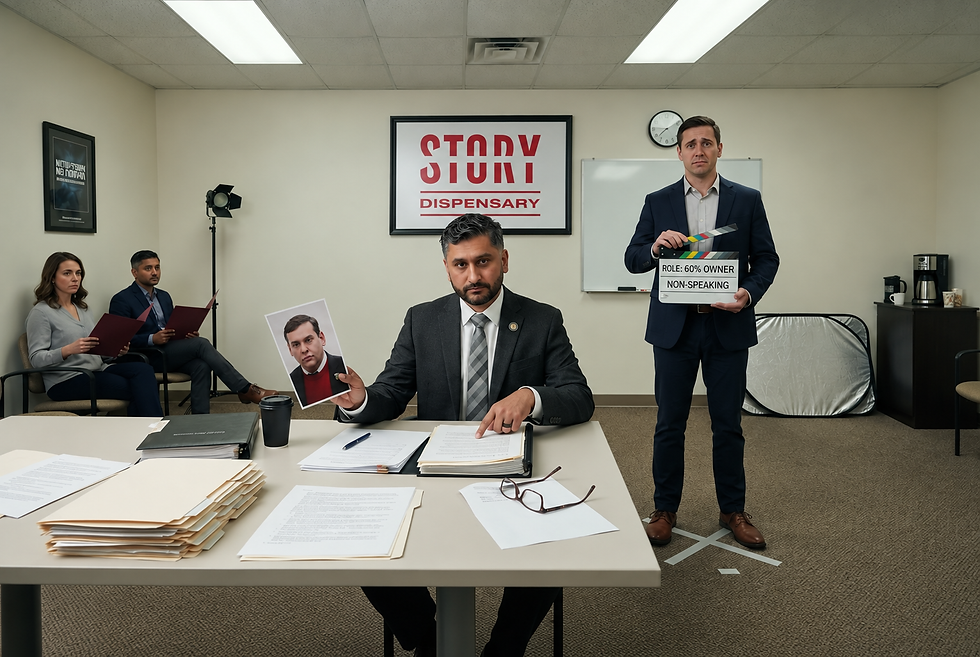
New Jersey’s newest cannabis casting agency is seeking qualified majority owners capable of appearing prominently on license applications before disappearing from business operations.
TRENTON, NJ — New Jersey State Sen. Raj Mukherji has opened auditions for the cannabis industry’s most demanding non-speaking role: Majority Social Equity Owner.
Successful applicants will portray the controlling owner of a licensed cannabis business throughout the regulatory approval process. Once production begins, performers will be expected to surrender all dialogue, remain outside major operational decisions and convincingly express surprise when the company’s debt becomes their character’s primary motivation.
The role requires applicants to appear on ownership documents at 60%.
Actual control is negotiable.
“This is an extraordinary opportunity for emerging talent,” reads the casting notice. “Selected performers will receive prominent billing on state applications, extensive exposure to regulators and the chance to be replaced after serving the narrative.”
No ownership experience is required.
Ownership is not necessarily included.
Seeking Diverse Talent for Paperwork-Based Role
Auditions are being held inside a windowless conference room containing three folding tables, 14 LLCs and a printer continuously producing management agreements.
Applicants are asked to bring identification, proof of social-equity eligibility and enough personal history to satisfy the New Jersey Cannabis Regulatory Commission. Headshots are optional, but a detailed description of the applicant’s race, neighborhood, criminal-justice exposure or economic disadvantage must be available for the licensing package.
A casting assistant greets each candidate and hands them a script titled Operating Agreement.
“You’ll be playing the 60% owner,” she explains.
“What are my lines?”
“There aren’t any.”
“What decisions do I make?”
“None currently written.”
“What do I own?”
“Sixty percent.”
“Of what?”
“That will be revealed during litigation.”
The production is specifically seeking minority applicants, women, veterans, impact-zone residents and people affected by cannabis prohibition. These qualifications are considered essential during licensing and subject to immediate creative differences once the dispensary is approved.
Applicants must also be comfortable signing incomplete documents under compressed deadlines and accepting the phrase “industry standard” as a substitute for independent legal advice.
Inspired by a Verified Complaint
The casting program follows a lawsuit filed September 30 in New Jersey Superior Court by Justin Shoham, a political consultant and former chief of staff to Mukherji.
Shoham alleges that Mukherji and a collection of cannabis businesses, investors and executives recruited qualifying social-equity owners to serve as “disposable figureheads” while affiliated parties retained practical control and extracted money through management, consulting, lending and lease agreements.
The 56-page verified complaint names Mukherji, CannTech, Story Companies, Best Buds Union, Jason Vedadi and numerous related individuals and entities. It alleges fraud, concealment, breach of contract, unjust enrichment, civil conspiracy and other claims. The allegations have not been decided by a court, and the defendants dispute them.
Shoham says he was recruited to become the 60% owner and managing member of Story Dispensary of Springfield. According to the complaint, his social-equity status, name and majority ownership position helped obtain and capitalize the company’s cannabis license, but he was later excluded from meaningful control.
That is the kind of commitment casting directors rarely see outside method acting.
Shoham remained so deeply immersed in the role of majority owner that the Springfield dispensary allegedly opened in April 2025 without his signature or anyone telling him.
“It’s a subtle performance,” explained one casting director. “The audience sees a controlling owner. The business sees a guy who apparently does not need to know when his own store opens.”
Majority Owner Must Be Comfortable With Minority Authority
The production’s official character breakdown describes the Majority Owner as “central to the application but not necessarily the plot.”
The performer appears during municipal approvals, state licensing interviews and ownership disclosures. Once the license is secured, management companies, lenders, landlords, consultants and experienced operators enter the story and begin receiving most of the dialogue.
The majority owner remains available for regulatory close-ups and debt scenes.
Shoham’s complaint alleges that Story Dispensary’s ownership documents gave him a 60% interest and managing-member status. It also alleges that a revolving credit facility began at $3 million with 18% annual interest and was later proposed for expansion to $4 million.
EMNJ Management allegedly received 11% of gross revenue, with a $20,000 monthly stipend credited against that fee. A related entity collected rent through a sublease arrangement.
The complaint describes these agreements as mechanisms used to remove economic value from the dispensary while leaving the licensed company carrying operational costs, debt and regulatory exposure.
In entertainment, this is known as backend participation.
The social-equity owner is promised ownership on the backend, then discovers everyone else has already participated in it.
The Five-Minute Audition
Candidates who survive the initial screening proceed to the signature challenge.
Each applicant is placed in a conference room with several incomplete agreements, a silent countdown clock and an attorney representing someone else.
They have five minutes to sign.
Requesting independent legal review results in an immediate note from producers that the applicant is being “difficult.”
According to Shoham’s complaint, agreements were sometimes transmitted under compressed deadlines, in incomplete form and with active discouragement of independent legal review. He alleges Mukherji pressured him to execute documents quickly and later repudiated promises about his compensation and ownership value.
Mukherji denies the allegations and says the lawsuit misrepresents a failed business relationship. He told reporters that he had not been involved with the company for years, that the Springfield franchise lost millions and that Shoham was the only person who received money.
Attorney Lee Vartan, representing Story-related defendants, called the complaint a shakedown. He said the disputed documents were prepared by experienced counsel, complied with state law and were disclosed to and approved by regulators. Story maintains that it committed millions trying to save a business that never became profitable.
This denial has been incorporated into the casting process.
Applicants are now told that if the dispensary succeeds, the experienced operators saved it. If it fails, the majority owner breached a fiduciary duty. If the owner complains, the entire production becomes a simple business dispute that has been unfairly recast as a conspiracy.
It is the only role in cannabis where the performer can receive top billing and sole responsibility without being allowed near the director’s chair.
P.O. Box 420 Handles the Paperwork
Several entities described in Shoham’s complaint shared the mailing address P.O. Box 420 in New York.
This is a real detail.
Apparently, the alleged architecture of a multimillion-dollar cannabis ownership dispute passed through P.O. Box 420 because subtlety had already left the building.
The address was associated in the complaint with CannTech, Best Buds Union, BBNJ OpCo and BBNJ Opportunity Fund. Together, the entities allegedly participated in lending, consulting, management or operating relationships surrounding the disputed ventures.
The casting office has recreated the mailbox in its lobby as an interactive exhibit.
Applicants insert an ownership agreement into the slot. On the other side, it emerges as a management fee, an 18% loan and a sublease.
If the paper disappears completely, the applicant has been approved.
New Jersey’s Social Equity Costume Department
New Jersey created social-equity preferences because cannabis prohibition did not harm everyone equally. Enforcement fell disproportionately on particular communities while wealthier investors remained positioned to enter legalization with capital, attorneys and political access.
The policy was supposed to place ownership and opportunity with people who had absorbed the damage.
But ownership in cannabis can be manufactured for regulatory purposes.
A qualifying applicant may hold the correct percentage on paper while an outside lender controls the money, a management company controls operations, an affiliated landlord controls the building and an option agreement establishes how the owner will eventually be removed.
The application shows equity.
The agreements determine who receives it.
That gap has created an entire professional class of consultants capable of assembling a compliant-looking ownership structure around the person least likely to control the business. The qualifying owner becomes regulatory wardrobe: essential to the production’s appearance, expensive to replace before approval and conveniently removable once filming concludes.
The costume says entrepreneur.
The contract says prop.
The “Nil Valuation Equity” Scene
Shoham says seven conversations with Mukherji were recorded between March 2022 and February 2024.
The complaint alleges that during one 2024 conversation, Mukherji described interests like Shoham’s as “nil valuation equities” and told him, “Paperwork says nothing. Negative value.”
Mukherji disputes the lawsuit’s characterization of their relationship and maintains the claims lack merit.
The casting office nevertheless considers “nil valuation equity” a breakthrough description of the role.
It means an applicant can own most of the company when regulators count percentages, then own something worth nothing when the applicant asks to be paid.
Sixty percent becomes a commanding majority during licensing.
At buyout, it becomes decorative stationery attached to several million dollars of debt.
Candidates are tested on their ability to maintain both realities without visibly moving their lips.
No Experience Necessary, No Control Provided
The final audition takes place before a panel consisting of a politician, a multistate cannabis executive, a management consultant, a lender and an empty chair reserved for the majority owner.
Jason Vedadi, the principal of Story Companies, is named in Shoham’s complaint as an alleged co-architect of the disputed business arrangements. Vedadi and the Story defendants deny wrongdoing and say the Springfield structure was disclosed to state regulators.
The panel asks each candidate one question: “Why do you want to own a cannabis business?”
Applicants who mention building community wealth, repairing drug-war harm or operating an independent company are thanked and dismissed.
The successful answer is: “To help somebody else obtain a license.”
The winner receives a 60% interest, a commemorative headshot and directions to an opening ceremony whose date may not be disclosed.
The operators receive management fees.
The lender receives interest.
The landlord receives rent.
The consultants receive consulting fees.
The state receives an application celebrating social equity.
And the social-equity owner receives the opportunity to someday prove in court that the role was supposed to include ownership.
Auditions remain open until New Jersey regulators begin reviewing who actually controls the businesses they approved.
Minorities are encouraged to apply.
Speaking roles are not available.


Comments