

The SEC Hands a Former Grilled Cheese Truck a $43.9 Million Bill, and Somehow the Sandwich Was the Legitimate Business
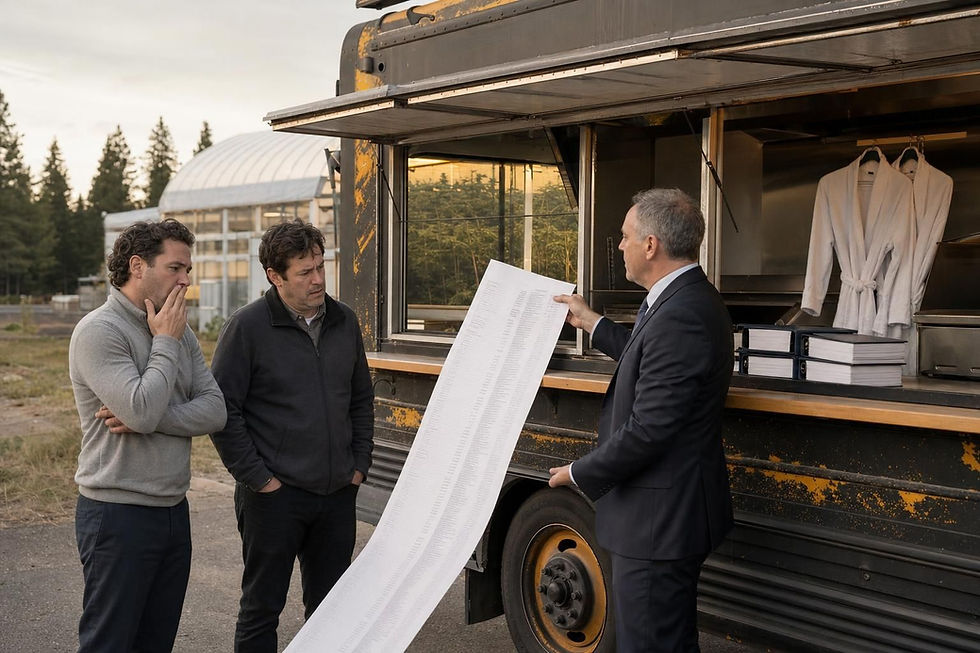
American Patriot Brands sold investors a cannabis empire with worldwide ambitions, one heavily encumbered Oregon farm, and a corporate history that began with melted cheese. Federal court has now priced the combo meal.
LOS ANGELES, CA. The United States Securities and Exchange Commission has completed the most expensive grilled cheese order in American history. The final tab is $43,866,935, before tip, and nobody gets to split it.
That is the combined disgorgement, interest, civil penalties, and individual monetary relief ordered in the SEC's case against American Patriot Brands, its affiliated entities, Robert Y. Lee, and Brian L. Pallas. APB was previously known as The Grilled Cheese Truck Inc., a sentence that already sounds like the judge lost control of the courtroom, but is both real and essential.
The company began with an honest proposition: give us money and we will hand you hot cheese between bread. It later pivoted into cannabis, where the proposition apparently became: give us money and we will hand you a story about an enormous Oregon farm, multistate operations, international reach, and investments safer than the available facts.
The sandwich phase had a kitchen, customers, and a window where the purchased object appeared. The cannabis phase had vertical integration, investor urgency, and a federal securities case. This is what MBAs call moving up the value chain.
Today's Special Is Disgorgement
The July final judgment orders APB, Urban Pharms, and The Tradition, Spirit & Liberty Group to disgorge $17,786,703 and pay $6,202,777 in prejudgment interest. It adds civil penalties of $4,729,004 against APB, another $4,729,004 against Urban Pharms, $2,364,502 against TSL, and $1,182,251 against DJ&S Investments.
Lee was ordered to pay $6,399,792. Pallas received a $472,902 civil penalty. Both men were barred from participating in securities offerings, except transactions for their own accounts, and barred from serving as officers or directors of public companies. Former CFO J. Bernard Rice had already consented to a separate judgment earlier this year totaling more than $1 million.
Those numbers are not an allegation, a projection, or an adjusted cannabis metric invented during an earnings call. They are the bill.
The Boof Market Desk attempted to place the total on a menu board. The exercise required six chalk colors, two ladders, and the removal of “market opportunity” because the phrase had become structurally unsound. One analyst proposed calling it the SEC Melt: $17.8 million of principal pressed against $6.2 million of interest, grilled beneath $14.2 million in company penalties, then served with individual sanctions on the side.
Nobody laughed. This was because the menu was still easier to understand than the capital structure.
The Farm Was Huge in the Investor Deck
The SEC said APB and its salespeople raised more than $30 million from more than 100 investors. The agency's 2023 complaint accused them of making false or misleading statements about the company's financial condition, the scope of its operations, the value of its Oregon cannabis farm, and the safety of the investments.
According to the SEC, investors were told the company operated across multiple states and around the world. Industry reporting on the case noted that APB had no operations outside Oregon. That is a minor geographic discrepancy if your map was produced by the same department that valued the farm.
APB promoted the Oregon property as one of the largest cannabis cultivation sites in the country. The operation reportedly produced little salable cannabis, and the farm was burdened by a lien that left questions about whether enough equity existed to secure what investors had been sold. The farm therefore achieved the cannabis industry's preferred state of matter: physically located in Oregon, financially located in a PowerPoint, and spiritually located wherever the valuation committee needed it.
Urgency was part of the pitch. Investors were encouraged to move quickly, which is generally useful when a person might otherwise have time to ask why a former grilled cheese truck possessed worldwide cannabis operations that could not be found outside one state.
The old food-truck model required health permits, fuel, ingredients, payroll, and the dangerous possibility that a customer could look directly at the product. The investment model was more efficient. It could serve projected scale without first cooking any.
The Executive Wellness Division
The SEC alleged that millions of dollars in investor proceeds moved into personal accounts and that tens of thousands paid personal expenses. Legal reporting on the case identified spa visits, clothing, hotels, flights for nonemployees, prepaid cards, and other purchases among the uses of investor money described in the record.
In a less innovative company, those would be expenses. In vertically integrated cannabis, they become departments.
The farm grew the narrative. The sales operation harvested the investors. The personal accounts handled processing. The spa delivered post-harvest remediation to management. Every important stage remained under common control, which is the exact kind of operational discipline shareholders had been promised, only pointed in the opposite direction.
At APB's imaginary annual meeting, the wellness segment reports exceptional same-store growth. A heated robe is presented as a hard asset. The eucalyptus room is classified as international expansion because one of the towels says “Turkish cotton.” A prepaid card issued to a relative becomes a strategic distribution partner.
This is the specific genius of cannabis finance during the industry's gold-rush years. Ordinary self-dealing arrived wearing a lanyard that said plant-touching. A lien became a secured opportunity. A barely functioning farm became scale. A founder's personal expense became founder-led conviction. If the money disappeared into a private account, the deck called it capital deployment and advanced to the slide with the enormous total addressable market.
Cannabis Did Not Invent the Con. It Supplied the Fog Machine.
It would be convenient to blame cannabis for this entire mess. The plant did not write the investor materials, move the money, value the farm, or book the spa appointment. Securities fraud existed long before dispensary menus began listing terpene percentages.
Cannabis did provide ideal cover. From 2016 forward, investors were trained to believe that every modest asset was one regulatory domino away from becoming a national empire. Federal illegality made basic comparisons difficult. State-by-state licensing made tiny footprints sound strategic. Banking restrictions excused unusual money movement. The public markets rewarded scale stories long before the underlying businesses proved they could produce ordinary profit.
In that environment, due diligence could be dismissed as a failure of vision. Questions about revenue meant you did not understand the growth curve. Questions about collateral meant you did not understand the regulatory moat. Questions about whether the company actually operated around the world meant you were focusing on current reality when management was discussing the addressable future.
The pitch did not need to make complete sense. It only needed to resemble the other pitches.
That is why APB matters beyond the names in the judgment. The case is a grotesque but recognizable version of the industry's oldest financing trick: replace proof with proximity to weed, then accuse the person asking for proof of lacking imagination.
The Sandwich Wins on Fundamentals
The most devastating comparison in the entire case is not between APB's projections and its actual operations. It is between American Patriot Brands and The Grilled Cheese Truck.
The truck's product existed before the sale. Its value could be tested immediately. Revenue arrived at the same window as fulfillment. A disappointed customer could return while the cook was still standing there. Even the collateral was honest. If the enterprise failed, everybody knew exactly where the truck was parked.
By the time cannabis finance finished improving the business, the company had more ambitious language, less visible substance, and a federal judgment large enough to purchase an alarming amount of actual cheese.
The Boof Market Desk therefore issues its first ever upgrade of a discontinued sandwich operation over its cannabis successor. The truck had stronger unit economics, clearer inventory, better transparency, and a more convincing international strategy, because a vehicle can at least cross a state line.
The SEC has closed the tab. Officer-and-director bars now block the exit. The investors are left with the oldest lesson in American business, reheated for the cannabis era: when somebody offers worldwide growth, secured returns, and a massive farm through the corporate remains of a lunch truck, order the sandwich.
At least the sandwich was real.


Comments